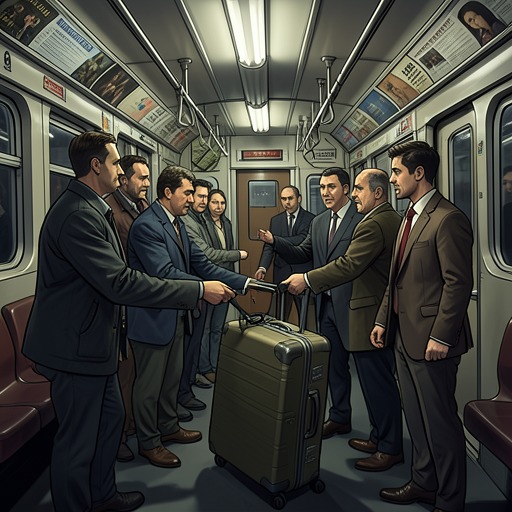
Nanao steals and hides the suitcase
Bullet TrainNanao steals and hides the suitcase aboard the Shinkansen while working for Minegishi, but the job he expects to finish quietly becomes a collision between competing claims and his own expectation of bad luck. The train’s narrow spaces, brief station stops, and moving crowds make the theft possible—and make the missing suitcase difficult to recover. Nanao’s effort to do the job properly is real; so is his growing suspicion that careful plans cannot protect him from unforeseen turns.
Commission and Opportunity
Nanao undertakes the theft on Minegishi’s behalf, with Maria relaying information and keeping in contact by phone. The work begins in the ordinary churn of a Shinkansen platform: passengers spill down the stairs, waiting lines dissolve, and people silently form new lines to board. Nanao notices how automatically he joins this collective movement. That flow of bodies offers cover, but it also places him inside a public space where every action risks being observed.
Once aboard, he takes a seat at the end of car four and watches his phone. The train is due to reach Ueno Station only minutes after leaving Tokyo Station, leaving little time to steal the suitcase. When a man carrying a torn paper bag bumps against him, Nanao apologizes to avoid friction, then points out the tear; the man brusquely tells him to mind his own business. This small encounter establishes Nanao’s habitual caution. He would rather apologize than invite a confrontation, even when the other person is at fault.
With four minutes remaining before the train reaches Ueno, Nanao finds the mid-sized, hard-sided black suitcase on the luggage rack. It has wheels and a sticker by its handle. He removes it as quietly as he can and walks back through car four and car five toward the gangway between cars five and six. He keeps an even pace and sees no one paying attention. The ordinary details of the bag and the routine passage between carriages give the theft its practical shape: Nanao must move an unmistakable object through a crowded train without making his movement look remarkable.
Concealment and Uncertainty
Nanao hides the suitcase aboard the train, with information later placing it in the storage area between cars three and four. When he learns it may be gone, he considers moving it closer to his seat, to the trash-receptacle panel in the gangway between cars four and three. He rejects that option because moving it might draw notice. For the moment, leaving it where it is seems safer. His reasoning is less a sign of confidence than an attempt to limit the number of new risks he creates.
Nanao repeatedly assures himself that the job will work out. He expects to leave at Omiya and believes that once he has done so, the work will be finished and Minegishi will have no reason to be angry. Maria warns him that even a job that seems impossible to botch can go wrong, or a different misfortune can intrude. Her warning has force because Nanao already interprets his life through the memory of being kidnapped on his way home from junior school. Bad luck, in his private logic, is not an abstract possibility but a recurring pattern.
The train’s physical conditions intensify his isolation. In the gangway, its swaying makes it hard for him to keep steady, while the racket of the tracks interferes with his conversation with Maria. He hopes the person who supplied the suitcase’s location might still be aboard and therefore on his side, but Maria points out that the informant’s task may have ended at Ueno. The distinction matters: information that seemed to promise an ally does not establish that anyone remains to help him.
The Missing Suitcase and the Search
Nanao decides not to get off at Omiya. He weighs the chance of searching the station against the chance of catching whoever has the suitcase aboard the train. On the platform, a thief could board another train or disappear into the streets; aboard the Shinkansen, the person carrying the bag would have fewer immediate opportunities to escape. Nanao also recognizes that staying on the train lets Maria tell Minegishi that he is still working. He does briefly step onto the platform to scan for someone running off with the suitcase, but the train’s length and the curve of the platform prevent him from seeing all the way to the front.
He comes to suspect that Tangerine and Lemon are involved. His most likely explanation is that he stole the suitcase from them and they stole it back. He is not certain; the possibility of a third party would make an already confusing situation more complicated. When he approaches Lemon, the encounter confirms that the theft has placed him in danger: Lemon realizes Nanao is connected to the suitcase and threatens to shoot him. Nanao keeps his voice low and insists that he is searching for the bag too, explaining that if it were at his seat there would have been no reason to come looking for Lemon. His attempt to recover the suitcase thus forces him to confront the men he fears may have taken it.
A Shared Employer, Competing Claims
The encounter with Lemon exposes the central reversal in Nanao’s job. Nanao tells Lemon that Minegishi hired him to steal the suitcase, though he does not know why Minegishi did not tell Tangerine and Lemon. Lemon reads the secret commission as evidence that Minegishi may not trust his established contractors. The suitcase is therefore more than stolen property: its journey reveals that several people are acting for the same employer without sharing the same information or understanding of the assignment.
Nanao’s account does not establish precisely who has the suitcase at every point. He reasons that Tangerine and Lemon took it back, but still frames this as the likeliest explanation rather than proven fact. When he says it is not at his seat and that he came to find them because he thought they had it, he is both giving his account and trying to survive an armed confrontation. His vulnerability follows from the structure of the job: Minegishi’s concealed arrangement has left Nanao exposed to men who regard him as a thief, even though he is also carrying out Minegishi’s instructions.
The theft consequently becomes an early demonstration of Nanao’s predicament. He proceeds methodically, watches the clock, avoids unnecessary friction, and chooses the search strategy that seems to offer the better odds. Yet each precaution opens onto another uncertainty: the informant may be gone, the suitcase may have changed hands, and the people pursuing it may not know he was hired. The train keeps moving while Nanao tries to make a simple assignment hold its shape; the suitcase’s disappearance turns that assignment into a contest whose rules were concealed from him.